Generic Name: Telmisartan + Amlodipine
Regulatory Class: Rx
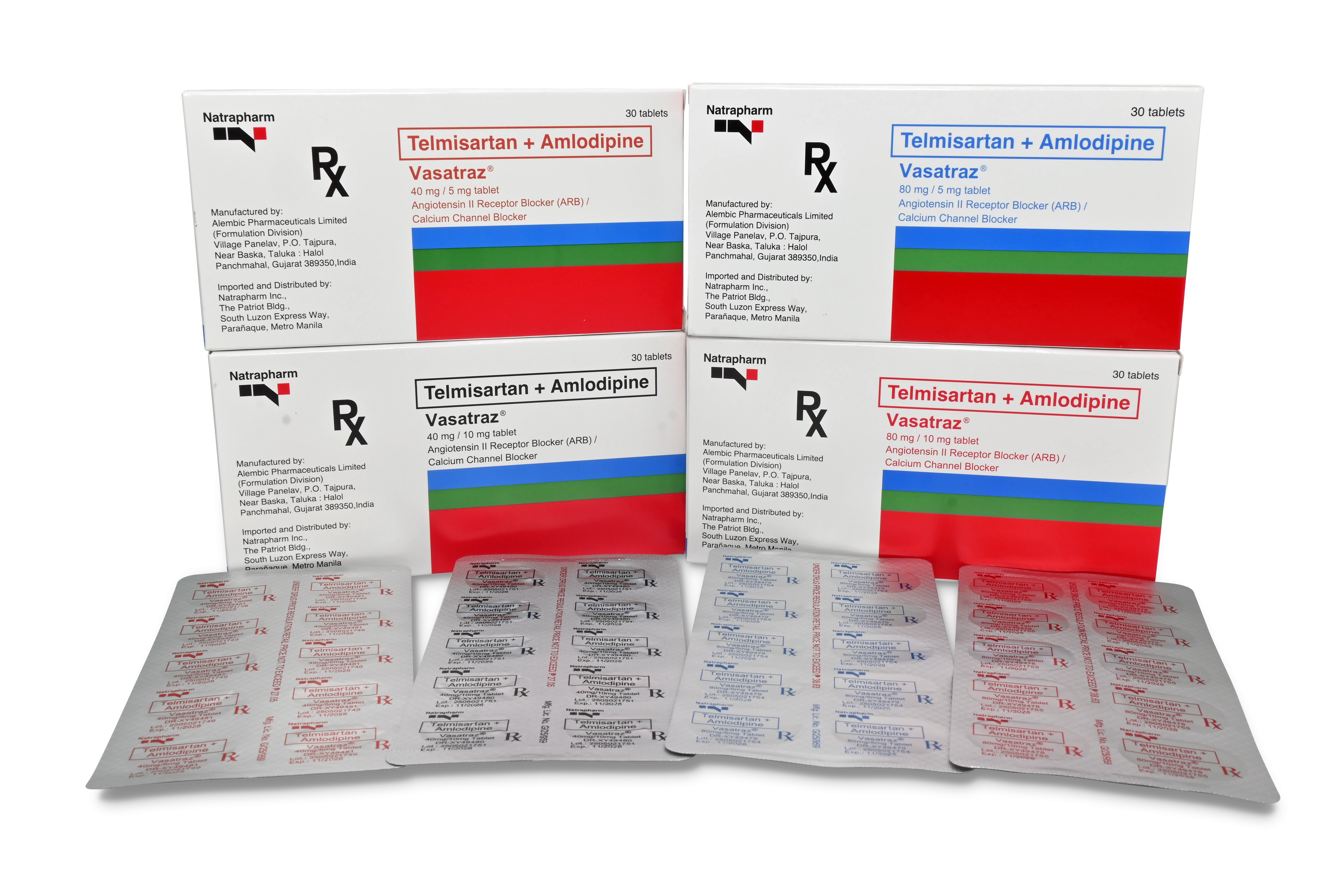
Formulations: Per 40 mg/5 mg tab Telmisartan 40 mg, Amlodipine 5 mg. Per 40 mg/10 mg tab Telmisartan 40mg, Amlodipine 10 mg. Per 80 mg/5 mg tab Telmisartan 80 mg, Amlodipine 5mg. Per 80mg/10mg tab Telmisartan 80mg, Amlodipine 10mg
Indications or Uses: Essential hypertension (HTN) as add-on therapy in adults whose blood pressure (BP) is not adequately controlled on amlodipine 5 mg alone or as replacement therapy in adults receiving telmisartan & amlodipine from separate tab.
Dosage or Directions for use: 1 tab/day. Max: One 80 mg/10 mg tab/day. Patient whose BP is not adequately controlled w/ amlodipine 5 mg alone 40 mg/5 mg daily. Patient treated w/ amlodipine 10 mg who experiences any dose-limiting adverse reactions eg, oedema May be switched to 40 mg/5 mg tab once daily. Patient receiving telmisartan & amlodipine from separate tab Same component doses in 1 tab once daily. Patient w/ mild to moderate hepatic impairment Telmisartan should not exceed 40 mg once daily.
Administration: Telmisartan and amlodipine tablet can be taken with or without food. It is recommended to take Telmisartan and amlodipine tablet with some liquid. 
Contraindications: Hypersensitivity to telmisartan, amlodipine, or dihydropyridine derivatives. Shock (including cardiogenic shock). Obstruction of the outflow tract of the left ventricle (eg, high grade aortic stenosis). Hemodynamically unstable heart failure after acute Myocardial Infarction (MI). Concomitant use with aliskiren-containing medicinal products in patients with Diabetes Mellitus (DM) or renal impairment (GFR <60 mL/min/1.73 m²). Biliary obstructive disorders & severe hepatic impairment. 2nd & 3rd trimesters of pregnancy.
Special Precautions: Increased risk of severe hypotension & renal insufficiency in patients with bilateral renal artery stenosis or stenosis of the artery to a single functioning kidney. Correct volume &/or Sodium-depletion prior to administration. Dual blockade of renin-angiotensin-aldosterone system (RAAS) through combined use of ACE inhibitors, ARBs or aliskiren is not recommended. Associated with acute hypotension, hyperazotaemia, oliguria, or rarely acute renal failure, in patients whose vascular tone & renal function depend predominantly on the activity of RAAS (eg, patients w/ severe congestive heart failure (CHF) or underlying renal disease, including renal artery stenosis). Caution in patients suffering from aortic or mitral valve stenosis, or obstructive hypertrophic cardiomyopathy. No data to support use in unstable angina pectoris & during or within 1 month of an Myocardial Infarction (MI). May cause hyperkalaemia; closely monitor serum K in patients with risk factors for hyperkalaemia. Excessive BP reduction in patients w/ ischaemic cardiomyopathy or ischaemic CV disease could result in MI or stroke. Caution in patients with hepatic impairment; severe renal impairment or haemodialysis. Periodic monitoring of Potassium (K) & creatinine serum levels is recommended in patients with impaired renal function. No experience on administration in patients with recent kidney transplant. Not recommended during breast-feeding. Safety & efficacy in childn <18 yr have not been established. Little information is available in the very elderly patients. Telmisartan: Consider appropriate blood glucose monitoring in diabetic patients treated with insulin or antidiabetics. Not recommended in patients with primary aldosteronism. Should not be used concomitantly with ACE inhibitors in patients with diabetic nephropathy. Not recommended during 1st trimester of pregnancy. Amlodipine: Associated with increased reports of pulmonary oedema in patients w/ NYHA III & IV heart failure of non-ischaemic aetiology. Concomitant use with grapefruit or grapefruit juice is not recommended.
Adverse Reaction: Dizziness; peripheral oedema.
Interactions: Increased BP-lowering effect with other antihypertensives. Hypotensive effects may be potentiated with baclofen, amifostine, neuroleptics or antidepressants. Orthostatic hypotension may be aggravated by alcohol. Reduced antihypertensive effect with corticosteroids (systemic route). Telmisartan: Attenuates diuretic-induced K loss. May lead to significant increase in serum K with K-sparing diuretics (eg, spironolactone, eplerenone, triamterene, or amiloride), K supplements, or K-containing salt substitutes. Reversible increases in serum lithium conc & toxicity. Dual blockade of RAAS through combined use of ACE inhibitors, ARBs or aliskiren is associated with higher frequency of adverse events eg, hypotension, hyperkalaemia & decreased renal function. Antihypertensive effect may be reduced w/ NSAIDs (ie, ASA at anti-inflammatory doses, COX-2 inhibitors & non-selective NSAIDs). Co-administration with COX inhibitors in patients w/ compromised renal function (eg, dehydrated patients or elderly patients w/ compromised renal function) may result in further deterioration of renal function, including possible acute renal failure, which is usually reversible. Increased AUC₀–₂₄ & Cmax of ramipril & ramiprilat. Median increases in digoxin peak plasma & trough conc. Amlodipine: Strong CYP3A4 inhibitors (ie, ketoconazole, itraconazole, ritonavir) may increase plasma conc of amlodipine. Plasma conc may vary w/ strong CYP3A4 inducers (eg, rifampicin, Hypericum perforatum). Bioavailability may be increased resulting to increased effect w/ grapefruit or grapefruit juice. Risk of increased tacrolimus blood levels. Variable trough conc increases of cyclosporine in renal transplant patients. Increased exposure to simvastatin.
Presentation or Packaging: Vasatraz® 40 mg/5 mg,
40 mg/10 mg, 80 mg/5 mg, 80 mg/ 10 mg Tablet (Box of 30's)
For more information on this product, please see the product insert.